

Thailand. 17 days where I didn't know what day it was.

Thailand. 17 days where I didn't know what day it was anymore
You leave Bucharest on one of those mornings when the cold doesn't hit you brutally, but it's enough to remind you with every breath that it's still winter. The sky is gray, the world is in a hurry, and your mind is already elsewhere, somewhere where you don't have to wonder whether or not you took an extra layer.
After a long flight where time gets mixed up and you don't know exactly if it's day or night anymore, you arrive in Phuket, and the moment the airport doors open, the warm, humid air welcomes you right in. It's not a gentle change, it's more of a sudden transition into another reality, where everything seems slower, softer, and more permissive.
It's not the temperature itself that changes you, it's the difference. The fact that in a few hours you've gone from a rigid world to one that doesn't seem to be rushing anywhere. The body doesn't really know how to react at first, but after a few minutes it stops analyzing and accepts the situation exactly as it is.
And that's where it all starts.
The first few days were exactly what you'd expect in a place like Phuket, but it took it a little further than you'd expect. Patong, in particular, is the kind of place that doesn't try to convince you of anything. It throws you right into it and lets you deal with it.
Bangla Road is not just a street, it's a phenomenon. Bars open to the street on both sides, different music from each direction, lights that don't take into account each other and people flowing continuously without seeming to have a clear destination. At first glance it looks like chaos, but if you stay long enough, you start to see a kind of order that is unlike anything you've ever seen.
There we ended up in an Irish Pub that, theoretically, had nothing to do with the place, but in practice it was exactly what was needed. We started quietly, continued less quietly and, at some point, we found ourselves playing pool with the waitresses, who turned out to be much better than us. I don't know exactly when the rhythm of the evening changed, but I know how it ended: in a red Tuk-Tuk, with the hot air in front and "Made in Romania" sung loudly, without much care for the notes.
I didn't sing well. But I sang with conviction.
The next day we woke up late, around noon, with no regrets and no reason to rush. That was probably the moment we understood that the plan we made at home no longer had much relevance. On shifts like this, the body knows better than the program.
The third day came with a contrast I hadn't anticipated. After a mall that could have been anywhere in the world, we arrived at the elephant sanctuary. At first everything seemed simple and peaceful: the elephants there, us there, we gave them bananas, they ate, people took pictures.
But if you sit there long enough and look closely, you start to see things that don't quite fit into that picture. Especially in their eyes, where there's a stillness that's not quite stillness, but rather a kind of resignation that you can't ignore if you're paying attention.
We didn't discuss it much at the time, but everyone left with something in mind.
Maybe that's why the next stop came as such a stark contrast.
The shooting range completely changed the energy of the day. I chose a rifle with a scope, mostly out of curiosity, and the moment you hold it in your hands you immediately realize that it's not the kind of experience you should take lightly. The weight is real, the silence before the fire is oppressive, and for a few seconds, everything boils down to a single point.
After the first shot, however, the smell remains. There's something about gunpowder that you can't mistake. It instantly took me back to my army years, to the shootings of that time, to the same sensation that, surprisingly, hasn't changed at all.
Some things don't go away. They're just waiting to be rekindled.
The first day of riding came with the classic excitement: the engines lined up, the luggage prepared, the sun already up and the feeling that, finally, the part you came for is starting.
And, a few hundred meters from the hotel, before we even left the city, the first break came.
The key was missing.
There was no panic, no nerves, just that brief silence where everyone quickly calculates what to do. The Harley dealer in Phuket was close by and things were resolved simply, without complications. We moved on and, somehow, that's where the real tour began.
Because in the following days, there was almost no motorcycle that didn't have something ticking. A clutch cable that gave out on the road, a battery that decided the story was over, the guide's air filter that also created a moment.

Nothing serious, nothing to stop the ride, but enough to constantly remind you that on the long road, things never go perfectly.
I solved them one by one, without rushing, without stress, with that calm that comes from experience. In a way, the small problems became part of the rhythm.
My motorcycle didn't ask for anything. It just went head to head without comment. I don't know if it was merit or luck, but in the end it doesn't matter.
Instead, it became apparent pretty quickly that it wasn't just motorcycles that needed adaptation.
Bang, our guide, started at a cautious pace, perhaps too cautious for what we were used to. He walked carefully, calculatedly, as if each of us were his direct responsibility in the strictest sense.

At the first appropriate opportunity, we had a simple discussion, without demonstrations, we just showed him that we knew what we were doing and that we could keep a more natural pace.
He understood quickly and, more importantly, he had the courage to change something. Not all at once, but gradually. With each passing day, the rhythm became more consistent, the stops became more fluid, and the walk began to flow.
In the end, it wasn't the guide leading us anymore. It was part of the group.
In parallel, there was a man who did not need any adaptation period.
Danela.
Rocker look, stage energy and a voice that couldn't be ignored even if you wanted to. In every bar with live music, the scenario was the same. He didn't wait for the invitation, he didn't analyze the moment, he just went on stage.
And within seconds it became clear to everyone why.
His voice was strikingly similar to Brian Johnson's, and when he started playing AC/DC songs, the difference between the original and what you heard there became surprisingly small. The audience quickly went from amazement to enthusiasm and, inevitably, to requests for another song.
I don't know if Danela was looking for the scene or if the scene found him, but at the end of the shift there are a few bars in southern Thailand that certainly won't forget him anytime soon.
In between all of these moments, the road flowed steadily. Thailand, at least on our route, is not about technical corners or sections that keep you on edge. The asphalt is good, the traffic surprisingly disciplined, but there are many long, straight stretches.
At first you feel like something is missing. Then, gradually, you get into a different kind of rhythm. You stop analyzing every curve, every brake, you just let the road flow. It becomes almost meditative.
It's not the kind of riding that gets your heart rate up. It's the kind that calms it down.
Every now and then, moments arise that completely break this rhythm.
A temple where the silence begins from the stairs and follows you without you realizing it. A palm forest where the light falls in perfect strips. A coast where fishermen show you the day's catch with simple, direct pride.
At one point, one of them showed us a long fish with venomous spines that left no room for error. The explanation was calm, almost relaxed. For them, it was something normal.
For us, it was enough to not touch anything.
In Kanchanaburi I discovered a Buddhist gong that wasn't struck, but was set in motion by friction. With your palms, you started drawing circles on its edge, and slowly the metal would start to vibrate.
Before the sound became loud, there was a sensation in the palms, a strange warmth that did not come from outside, but from the vibration. The sound itself was not just heard, it was felt.
The next day, Erawan Waterfall came as a reset. Five kilometers of walking, seven levels, cold and clear water. At each level you had the impression that you had reached it, but there was still one higher.
Fatigue was building up, but it was the good kind, the kind that comes from being present.
In the evening, on a boat, with live music and warm lighting on the water, he closed the day without haste.
Then came the islands.
Ko Samui changed the pace from the first. The ferry, the water, the island slowly appearing on the horizon, all force you to slow down.
Krabi took the sensation further. Railay Beach, accessible only by boat, with its limestone cliffs and turquoise water, seemed detached from a too-well-made setting.
On the alleys, among the vegetation, shops selling unexpected things, treated with a disarming normality. Above, a young monkey walked on cables, completely unconcerned.
The day ended simply, with good food and a cold drink, without rushing.
And then came Poda.



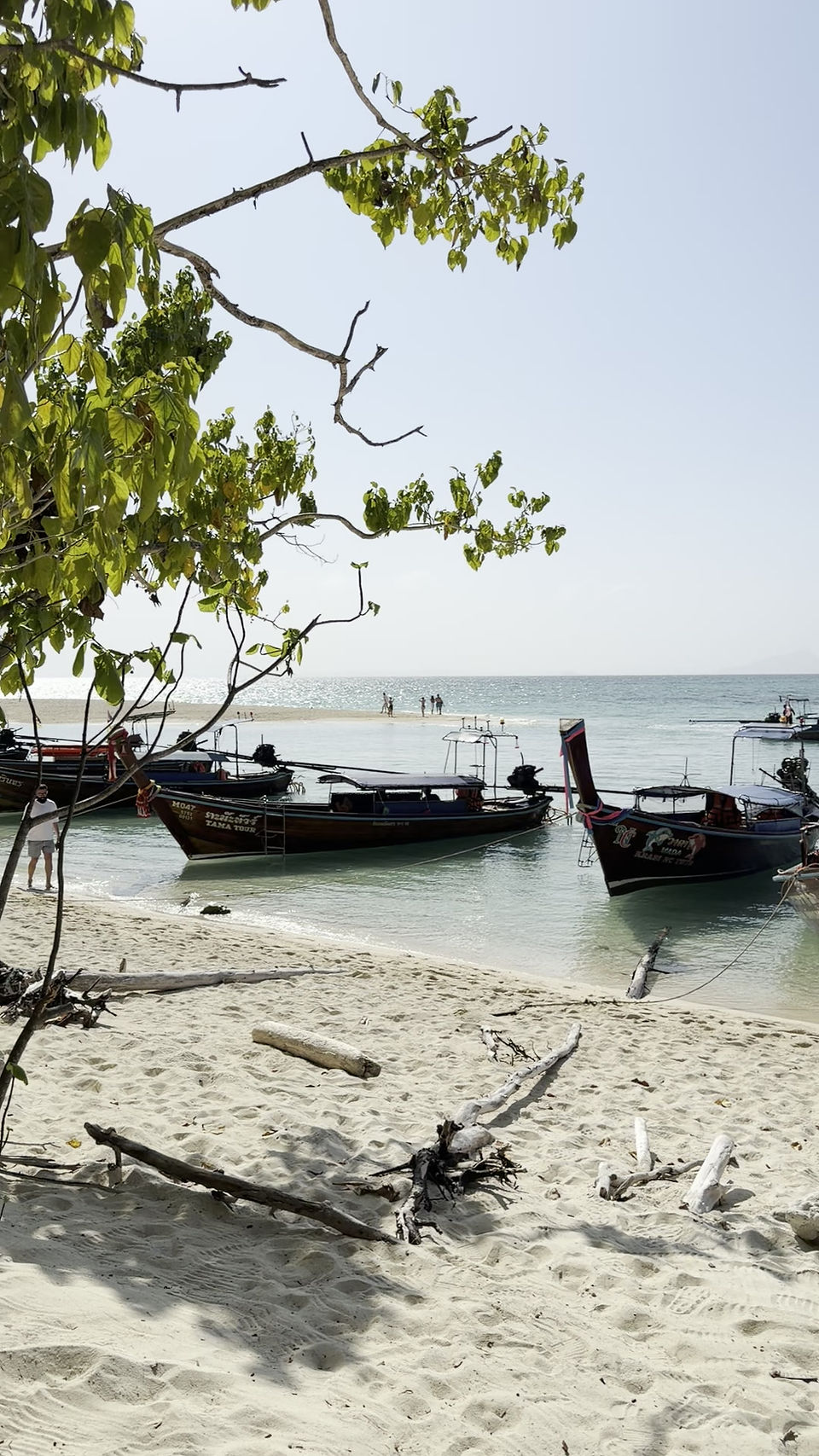

The kind of place you see and know from the first moment that you won't be able to explain it properly to anyone. The water has a color that doesn't capture in pictures, the sand is too clean, and the silence is complete.
We wanted to stay overnight. It wasn't possible.
And, as always, when the plan doesn't work out, the story emerges.
A motorcycle that won't start. The baggage car that breaks down. The key forgotten again.
I left late. But I left laughing.
Towards the end, one of those moments that needs no explanation appeared.
One morning, several doorknobs had traces of Nutella on them.
Nobody asked. Nobody explained. And nobody admitted.
It stayed that way.
The last day came without haste. Old Town, narrow streets, muted colors, small shops and the feeling that time is no longer an issue.
We arrived again at the restaurant we liked the most and caught the sunset for the second time, this time after a short rain that completely changed the light.
In the evening, at Bang's bar, it all ended.
Danela went back on stage, the music started, the crowd gathered, and at some point, a torrential rain began.
Nobody moved.
It wasn't the kind of rain you ran away from. It was the kind that closed a road.
After 17 days, it didn't matter what day it was.
I left Bucharest with curiosity and returned with gratitude. Not because everything was perfect, but because even when it wasn't, it was good enough to become part of the story.
Bang was no longer a guide. Danela needed no introduction. And somewhere, in a hotel in Thailand, there are doorknobs that tell a story that no one will ever explain.
Next time I already know two things.
A night on Poda. And a route with many curves.
The rest comes naturally.




Comments