

The Holy Cow - India, the Himalayas and my first real off-road adventure

I didn't want to go to India.
I think it's important to say this up front, especially since this article is about a trip that I ended up loving. I had a problem with India before I got there, and the problem was, quite simply, misery. I had seen enough pictures, read enough stories, and had a pretty clear picture in my head of what I was going to find there, and I wasn't at all eager to check if my picture was accurate.
However, when OmBun told me it was a motorcycle expedition through the Himalayas, things changed. I wasn't really interested in India, but the Himalayas... well, Himalayas is the kind of word that makes you look twice at the offer.
That's how I ended up leaving for Delhi, with some excitement because it was going to be my first real off-road experience and with a book in my luggage, "The Arc de Triomphe" by Erich Maria Remarque, which I finished on the plane, because, obviously, I can't sleep on a plane even if the plane is empty and someone reserves three seats for me.
We did the expedition together with Wanderlust Expeditions , and because any serious journey needs a name, we named it "Holy Cow".
I don't think there's a more appropriate name for a gang of Romanian bikers heading to India on Royal Enfield Himalayans.

And I had another emotion. Not just for India, but for the fact that I was going to ride a motorcycle for the first time on terrain that you couldn't really call a road anymore.
Or, at least, that's what I hoped.
I arrived in India with Remarque in my head.
Long flight. I didn't sleep at all. Luckily, I had "The Arc de Triomphe" by Remarque.
I finished it on the plane.
And, looking back, I don't know if I chose the best book for the beginning of a trip to India or, on the contrary, exactly the right book.
Remarque talks about people trying to move on in a hard, oppressive world, where deprivation, insecurity, and the past leave their mark on every day. I closed the book on the plane and, a few hours later, opened the plane door in Delhi.
The air was warm and humid and hit me right in the face. It wasn't the dry, clean air you get off a plane at a mountain destination; it was thick, sticky, and smelled of something I couldn't identify.
I'm not saying that today's India has any direct connection to Remarque's Europe, nor do I want to make a forced comparison between things that are not comparable. But that feeling of a heavy, crowded world, where people carry on with their lives regardless of the conditions, somehow continued my reading into the real world.
And maybe that's why my first impression of Delhi was so strong.
I arrived at the hotel, dropped off my bags, and walked around the city for a bit. I was tired, sweaty, and still trying to figure out what I was actually doing in India.
The first surprise came at Humayun's Tomb.
I still call it, from memory, "the garden tomb."
And that's exactly what it is, except that it's a "garden tomb" almost 500 years old and of a beauty that makes you forget about Delhi for a few minutes. Built in the 16th century, Humayun's Mausoleum is considered the first great example of a garden tomb of this type in India and influenced the Mughal architecture that would reach, a few decades later, the Taj Mahal. The complex has been included in the UNESCO heritage since 1993.
The red sandstone, white marble, geometric gardens, and tranquility inside were nothing like the world I had left at the gate.
And that was to be one of the themes of the entire trip: India could impress me and annoy me in the same half hour.
Sometimes even on the same street.
Delhi confirmed my prejudices
The next day we saw Old Delhi.
And then I understood exactly why I hadn't wanted to come.
There was a lot of mess. Not "a little unkempt", not "a different standard of cleanliness", but an amount of garbage, dust, smells and chaos that I could hardly process. The traffic was a mix of cars, motorbikes, tuk-tuks and people who each seemed to circulate according to their own rules, and the horns were a constant background sound.
People looked at us curiously. And they probably had a reason. We were very white Europeans in a city where we didn't fit in at all.
Instead, the food...
I have to say something here.
The food is extraordinary.
At least what I ate. And, since in India I ate something I liked at almost every meal, I have to admit that Indian cuisine has started to repair a little of my relationship with the country.
Then we arrived at the Lotus Temple.
The Baha'i Temple is shaped like a lotus flower and is made up of 27 marble petal-like structures arranged on nine sides. In the middle of a city where everything seems to be in motion, this white and immaculate structure seems almost unreal.
I entered.
Quiet.
And again I had the feeling that India cannot be understood from a single image.
You can be on a street that smells bad, among garbage and honking horns, and after a few minutes be standing in a place of almost perfect beauty and tranquility.
I just had to get used to the contradiction.
After Delhi, we got on the bus and headed for the mountains.
It was a long way, but I was already impatient.
The further we got from Delhi, the more the landscape changed. The city was left behind, the air became colder, and instead of the absurd traffic, mountains began to appear.
When we arrived, we were picked up by the hotel staff, we ate quickly, and slept for three to four hours.

After that we received the motorcycles.
Royal Enfield Himalayan.
My first adventure motorcycle.
First impression?
It's not fussy at all.
Woe to her star.

But she's comfortable, and after the first walk to get used to it, I started to think we might get along well.
The Himalayan is not the kind of bike that makes you crave acceleration. It doesn't urge you to go fast, nor does it seem interested in proving anything.
It seems more like the kind of motorcycle that says, "Come on, get on and let's see where we go."
And that's exactly what we were going to do.
The first few days weren't what I would call true off-roading.
We had asphalt, bad roads, unpaved sections, and enough potholes to understand that in the Himalayas the notion of a "good road" is quite relative, but the day we were waiting for had not yet come.
One day I rode about 100 kilometers and climbed to an altitude of 2,600 meters. The road became more and more interesting, the scenery more and more spectacular, and I was starting to get used to the motorcycle.
Then we had a day of about 200 kilometers, with very little asphalt.
There I began to understand what it really means to walk through the Himalayas.
The mountains are massive, and the road sometimes looks like a simple line drawn along their edge. The rivers appear far below you, and in some places you have the feeling that someone built the road just to prove that it was possible.
In the evening we arrived at the tent.
Rudimentary tent, spartan conditions, washed in a basin.

It wasn't exactly what I call a vacation.
But it wasn't unbearable either.
You adapt.
Especially when you open the tent in the morning and the Himalayas are in front of you.

As we went deeper into the mountains, the landscape changed completely.
Spiti Valley.
Here the Himalayas no longer look like you imagine a mountain. You no longer have green forests and slopes covered in vegetation everywhere. You have a cold, high-altitude desert, with arid mountains, rock, dust, and villages that appear like green islands in the middle of an almost colorless landscape.
Spiti is one of the remote regions of Himachal Pradesh, and connectivity is still difficult; even tourism authorities say that mobile network is limited in the valley and that the terrain and altitude make travel difficult.
And that's what it feels like.
You feel like you've stepped out of the ordinary world.
The road continues, the mountains continue, and people live in a few villages located in places where I wouldn't have had the courage to even build a shed.
One of the places that stuck in my mind is Key Monastery.

The monastery is perched on a volcanic hill at an altitude of about 4,100 meters, and is the largest of the monasteries in Spiti. It is a veritable labyrinth of rooms and corridors, with religious paintings, thangkas, ancient musical instruments, and manuscripts.
From the outside, it looks like someone took several buildings and stacked them on top of each other on the mountain.
From the inside it is completely different.
Small rooms, dark corridors, old wood, the smell of incense and little light.
And, for a few minutes, you forget you got there on a motorcycle.
I looked at that place and thought about how difficult it must have been to live here hundreds of years ago and how different the world must have been for the people who built the monastery.
We came with Royal Enfields, technical equipment, GPS, phones and cameras.
They came here with almost nothing.
And they built a place that still exists.
In Spiti, there is also that kind of objective that, said out loud, seems invented.
Hikkim.

And its famous high-altitude post office.
In a region where internet and telephone are not always things you can rely on, the existence of a post office here almost seems like a good joke of history.
But that's exactly what I liked.
While we send photos and instant messages from anywhere, here people still use such an old and simple solution: the letter.
At over 4,000 meters, some things don't need to be reinvented.
And finally, the off-road day
Up until now, I've been wondering if what we do can truly be called off-road.
I had had bad roads, gravel, broken asphalt, unpaved sections, and enough potholes to convince myself that the motorcycle's shock absorbers were working harder than I was, but I still hadn't had that day when I could say:
Yes. That's it.
It came towards the end.
Over 100 kilometers.
All off-road.
And here, finally, I understood why I came with the Himalayan.
The road was no longer a bad road that, with a little goodwill, you could have called a road. It was simply terrain.
Stones, ruts, dust, climbs and descents, sections where you had to choose very carefully where the wheel goes, and moments when you had the impression that the motorcycle had more ideas about the route than you did.
This is where I started to ride in the steps and let the bike do the work underneath me. I stopped trying to control every move and began to understand that, on terrain like this, sometimes the best thing you can do is not fight the bike.
Let her move.
Let her seek adhesion.
Look further.
Choose the line.
And, above all, don't stare obsessively at the front wheel.
There were parts where the bike moved under me like an MTB, and the feeling was extraordinary. I was no longer riding the bike on a road, but rather riding the bike over the terrain.
And here I had the revelation.
I like off-roading.
I wasn't necessarily expecting this.
I went out of curiosity to see if I liked it and found myself, after a few hours, not wanting the day to end.

And, somewhere in all this madness, we reached 5,100 meters.
5,100.
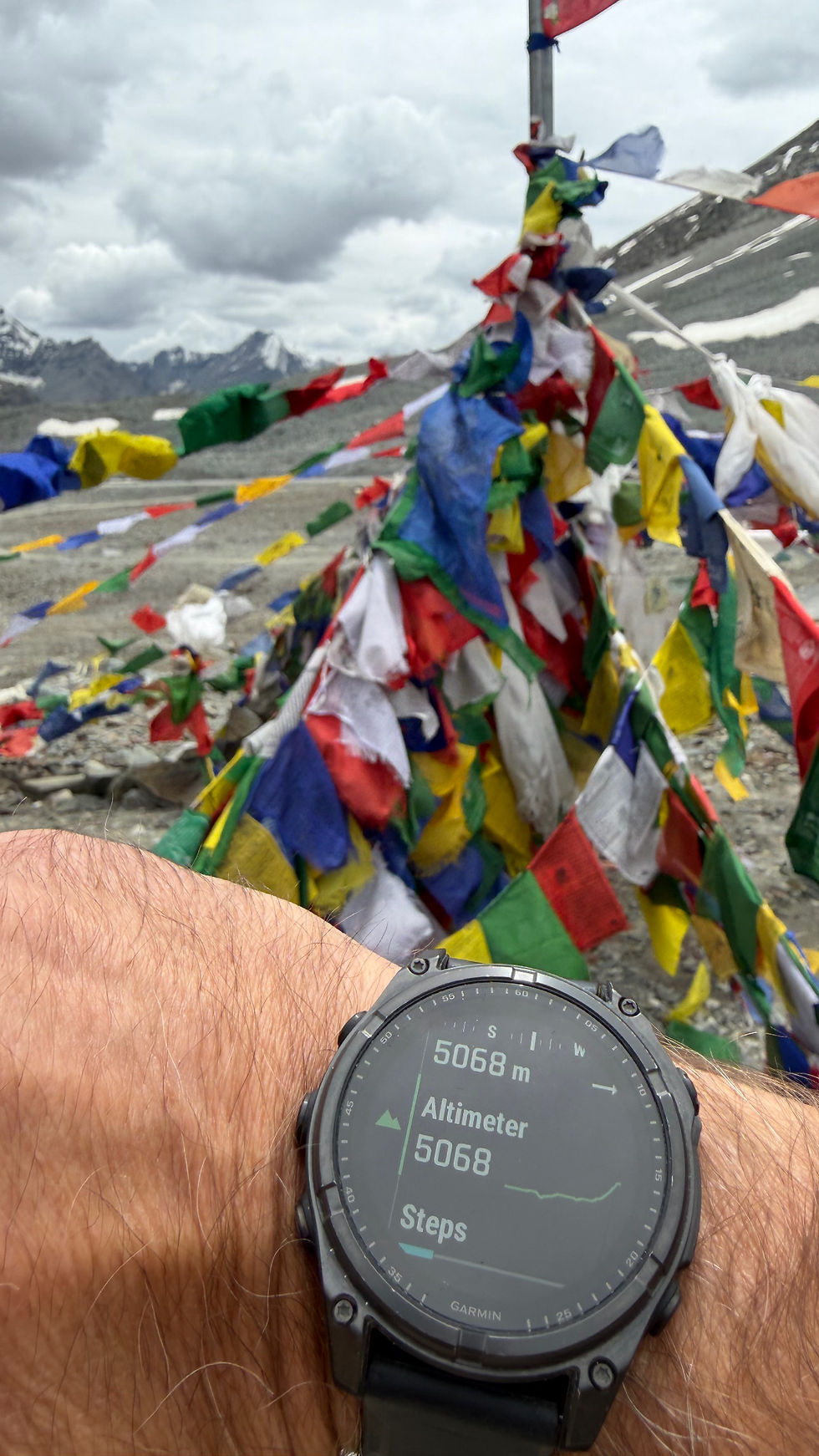
The number sounds simple until you get there.
Then you begin to understand that the mountain has its own rules and that it doesn't care at all that you are used to breathing without thinking about it.
You move slower.
You breathe differently.
You stop more often.
And every stop becomes a reason to look around.
I looked at the altimeter and realized that the man who had left Bucharest without particularly wanting to reach India was now standing at 5,100 meters, in the Himalayas, after days of riding his motorcycle.
That's one of the beauties of travel.
Sometimes you leave for one reason and end up living something completely different.
After mountains, rocks, and days of road construction that seemed like it was built with a shovel and a lot of stubbornness, we arrived at one of the most spectacular examples of modern infrastructure in the area.
Atal Tunnel.
A tunnel of approximately 9 kilometers that crosses the Pir Panjal massif.

Nine kilometers through the mountains.
You enter the darkness on your motorcycle and the sound of the engine changes immediately. The echoes bounce off the walls, the lights flash one after the other, and for a few minutes, you can't see the Himalayas anymore.
Just a tunnel.
I thought it was a very good image for the whole trip.
India can take you from a dirt road where you struggle with rocks directly into an engineering construction of such dimensions.
The contradiction continues.
After that day of real off-roading, most of the route was back on asphalt.
But in the Himalayas, asphalt doesn't mean boredom.
Long serpentines, steps, rivers that appear and disappear far below you, cliffs overhead, and roads that cling to the mountain in a way that, viewed from Romania, seems almost irresponsible.
And, every now and then, an Indian truck that makes you instantly reevaluate all the decisions you've made in life.
But the landscapes were so spectacular that we stopped often.
Engine stopped.
Helmet down.
Cold wind.
And peace.
A tranquility that in Bucharest you would probably pay for at a spa.
It was free here.
Finally, we returned to Manali and the moment came that you don't really expect after you start getting used to the motorcycle: we handed over the Himalayans.
At first I looked at this motorcycle and thought "oh my god".
In the end I had come to say:
"Wow, this motorcycle is really OK."
It's not fast, it's not spectacular in the classic sense, and it doesn't make you feel like a MotoGP rider.
But for what we did there, it was exactly what was needed.
And perhaps that's one of the best qualities an adventure motorcycle can have: not being the star.
To let you be.
We left the motorcycles there and got back on the bus.
The road to Delhi followed.
About 11 more hours.
When we arrived in Delhi, we went to a five-star hotel.
And I want to tell you something.
I don't think I've ever appreciated a five-star hotel so much.
Not for the pool.
Not for chandeliers.
Not for breakfast.
Not for room service.
It was clean.
That's it.
After tents, basins, and a few accommodation experiences that I prefer not to elaborate on, cleanliness had become a luxury.
I went into the bathroom and had probably one of the most satisfying showers of my life.
Then, in the evening, we went to a mall.
And I didn't think I would ever be able to truly enjoy being in a mall.
But I was happy.
Not for stores.
Not for shopping.
Because it was clean.

The floor was clean, the toilet was clean, the air was fresh, and for the first time in many days, nothing smelled of anything I didn't want to identify.
I realized then that, after getting used to certain conditions for a few days, you start to appreciate things that you don't even notice at home.
A clean bathroom.
A clean bed.
A shower.
Air conditioning.
Sometimes happiness isn't complicated at all.
Would I still go?
The next day I left for home with mixed feelings.
India has tired me out.
The mess bothered me and sometimes even depressed me. I don't think we need to gloss over this just because we enjoyed the trip.
But at the same time, the Himalayas showed me some landscapes that I can hardly compare to anything I've seen before.
Those massive mountains, the valleys, the villages, the monasteries, the roads, the tranquility and the feeling that you have arrived in a place where the modern world has remained somewhere very, very far away.
For that nature I would go back tomorrow.
For those roads, the same.
For Spiti, for Key Monastery, for the altitude of 5,100 meters and for that day of over 100 kilometers of off-road, without thinking too much.
But I would set a condition.
I would like clean accommodation.
I'm not asking for five stars.
I don't ask for a pool.
I don't ask for room service.
I just want to be able to go into the bathroom without feeling like I'm about to discover a new life form.
Otherwise, I'm ready.
Because the Himalayas are worth it.
I went to India without wanting to go to India.
I returned not knowing exactly if I loved India.
But I know for sure that I loved the Himalayas.
And maybe that's the beauty of a trip. You don't have to come back with a perfect conclusion. Sometimes you come back with questions, with images, with smells, with noises, with dust in your luggage, and with a few things you wouldn't have anticipated.
I, for example, went to see the Himalayas and came back with a personal discovery:
I like off-roading.
And, after more than 100 kilometers of real road, with a Royal Enfield Himalayan under me and the Himalayas all around, I think this is perhaps the most important conclusion of this trip.
And if you ask me if I would come back...
Yes.
For the Himalayas.
But, please, I...
let's find a clean accommodation. 😁


Comments